
Captain’s Log: The March Transition — 6 Days of Heavy Pressure on the Poerava
Trip Details
-
Trip Type: Blue-Water Pelagic & Drop-Off Jigging
-
Region: Mahé Plateau to the Eastern Drop-off
-
Date Range: 22–27 March 2026
-
Duration: 6-Day Liveaboard (Vessel: Poerava)

Environmental Conditions We are right in the middle of the “Austral Summer” transition. The Northwest Monsoon is starting to lose its bite, but the air remains thick with humidity (around 82%). This week, the winds were mostly light and variable, under 10 knots, giving us those “greasy” glass conditions in the mornings.
Water temperatures have climbed to a steady 29.5°C. The thermocline is shallow, which is good for the surface bite, but it meant we had to work harder with the electronics to find where the bigger fish were holding in the cooler layers. Tidal movement was consistent—we saw current speeds hitting between 4.8 and 5.7 meters per second during the middle of the run, which really pushed the bait up against the pinnacles.
Catch & Activity
-
Blue Marlin: 2 raised. One proper fish (est. 160kg) stayed deep and wouldn’t commit, and a smaller fish on a rigged Bonito near the 1,000m contour on Day 3.
-
Yellowfin Tuna: The surface action was the highlight. We found three separate schools “mouching” on the surface. We landed 4 fish, with the biggest “barrel” going 45kg on a sinking stickbait.
-
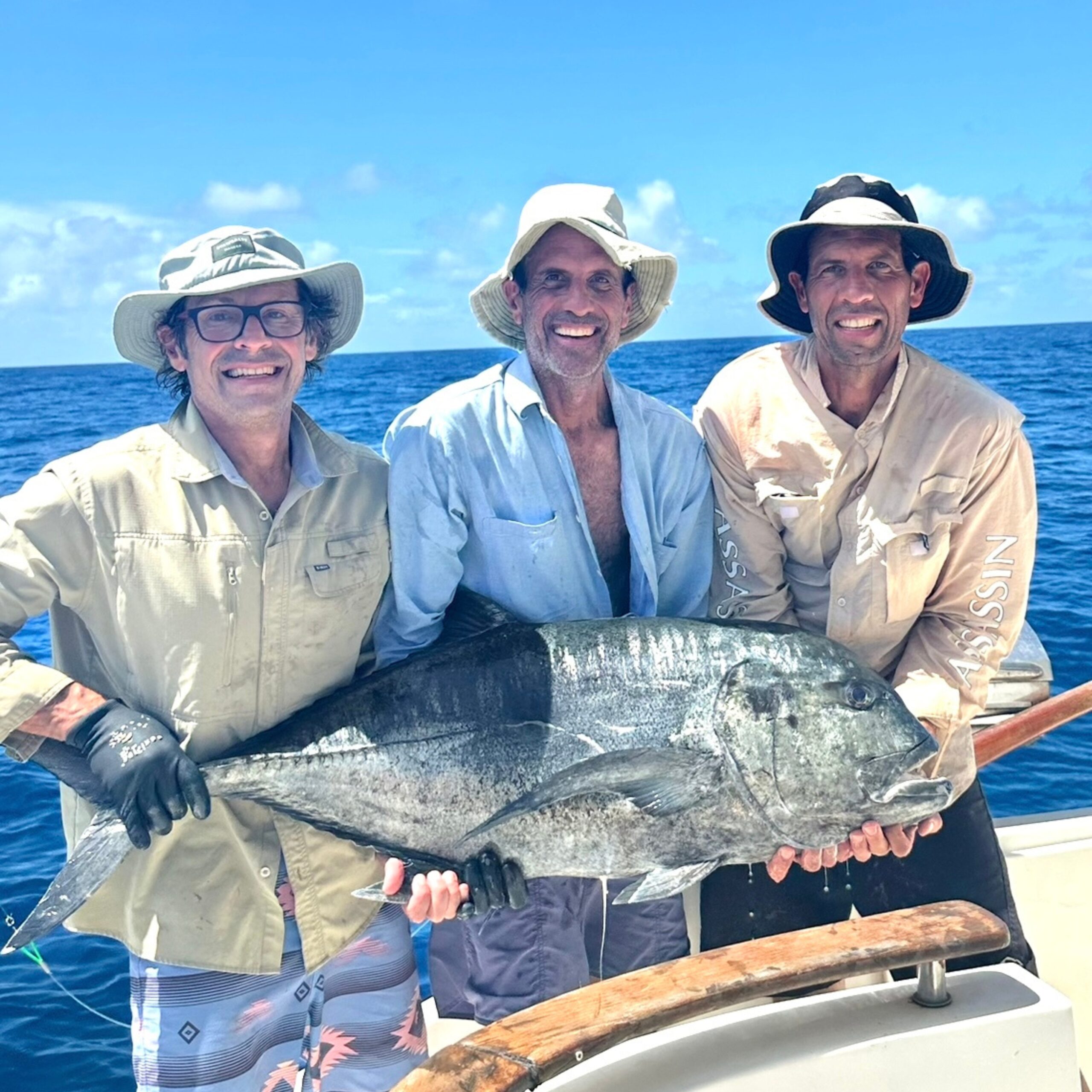
Dogtooth Tuna: 3 decent fish landed. The current on the 25th was perfect for the Doggy bite. We worked the 80m–120m ledges and got several violent strikes, though we lost a couple of real monsters to the reef.
-
Giant Trevally (GT): 6 landed. Most were taken on poppers around the shallower rocky structure as we moved back toward the Plateau.
The Mission: Highlights from the Water We cleared Eden Island Marina on the 22nd aboard the Poerava. This Fontane Pajot Maryland 37 is “light” in the water, but with the flat March seas, we were able to cruise comfortably at 7 knots to hit our marks early.
By Day 2, we reached the Eastern Drop-Off. The current was really starting to crank. We focused on vertical jigging. The Dogtooth were there, but they were being picky. It wasn’t until we switched to a faster, “mechanical” retrieve that we started getting the attention of the bigger fish.
The best session of the trip was Day 4. We spotted a massive bird workup of Sooty Terns and Noddies about 4 miles off the ledge. It was pure mayhem. The Yellowfin were pushing bait to the top, and we had triple hookups on light-tackle stickbaits for nearly an hour.
Tackle & Techniques
-
Popping: Big cup-faced poppers were raising fish, but sinking stickbaits in natural “Baitfish Blue” were what actually got the commit.
-
Jigging: We had to go heavy due to the current. 300g–400g Silver and Pink jigs were the only things reaching the strike zone.
-
Leaders: We stayed with 170lb monofilament for the popping. The water was so clear that anything heavier was spooking the fish in the midday sun.
Captain’s Insight The transition is definitely here. The sea is flattening out, and the Billfish are starting to move closer to the Plateau. My advice for the groups coming in April: watch the barometer. When it dips just before a squall, that’s when the bill fish are going to turn on.
We’ve also been checking the Redirection logs weekly to make sure our technical data is reaching you. If you’re looking for the technical truth of the “Northern Terminus,” our new Bird Island Guide is now live and updated with the 2025 regulatory data.
Plan your next offshore run: 👉 View trips and availability






Leave A Comment