
The Ultimate Guide to Dogtooth Tuna Jigging in the Seychelles
By Captain Andrew & The Screaming Reels Crew
Introduction: The Apex Predator of the Indian Ocean
Last Updated: January 2026 — Peak NW Monsoon Season
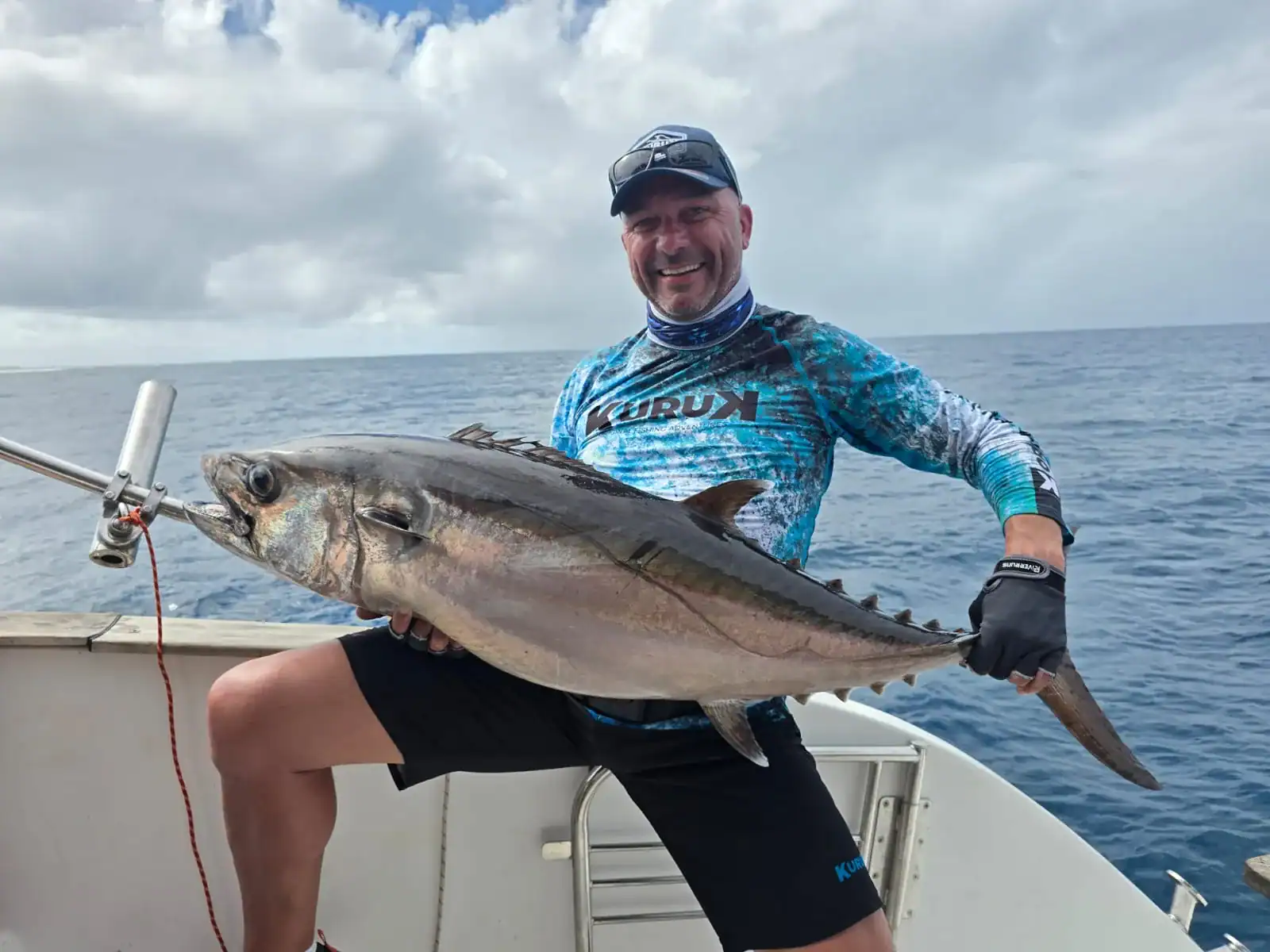
The Dogtooth Tuna (Gymnosarda unicolor), known locally as the “Doggy,” represents the ultimate challenge in tropical sportfishing. While other charters treat them as a “lucky bonus,” at Screaming Reels, we treat them as a mission. Operating deep in the Seychelles Outer Islands Poivre, African Banks, Remire etc) aboard the Hinatea, we specialize in the technical vertical jigging required to stop these apex predators before they wreck your gear on the granite reefs.
This guide provides the “Technical Truth” derived from decades on the water—moving beyond theory into the practical mastery required to land a 50kg+ trophy.
Quick Navigation: The Jigging Specialist’s Playbook
Biological Intel
Geographic Hotspots
Gear Arsenal
Technical Candence
The Fight
FAQ
Understanding Your Quarry: Dogtooth Tuna Biological
To catch a Doggy, you must understand why they are the most efficient “tackle-breakers” in the ocean.
The Swim Bladder Advantage
Unlike true tunas of the Thunnus genus, the Dogtooth possesses a large, functional swim bladder. This allows them to hover stationary on deep ledges or deep-water pinnacles without forward motion . They are ambush specialists. When your jig drops past a ledge at “The Kennels,” they aren’t chasing it from a distance—they are hitting it from a standstill with 50 mph explosive force .
Canine Dentition & Abrasion
Their conical teeth are designed for a “seize and hold” predatory style. While a 100lb leader might seem heavy, these teeth—combined with the jagged granite of the Amirantes—will shear through fluorocarbon in seconds.
Behavioral Ecology
Dogtooth tuna are non-pelagic apex predators that haunt the fringes of reef systems, seamounts, and deep underwater walls. While occasionally encountered in water as shallow as 1 meter when chasing bait onto the flats, they are most commonly found between 10 and 350 meters depth. Larger specimens are notoriously solitary or move in very small groups, unlike the massive schools formed by pelagic tunas.
Their immediate instinct upon being hooked is to seek the nearest “bommie” or coral outcrop to sever the line—a behavior that makes them one of the most difficult gamefish to land. This structure-seeking behavior means that the fight must be won in the first ten seconds, or it’s often lost entirely.
Diet and Feeding Behavior
As opportunistic carnivores occupying a high trophic level, dogtooth tuna share the crown with giant trevally, large groupers, and sharks. Their feeding habits are characterized by sudden, high-speed raids on schooling species. Primary prey includes:
- Rainbow Runners (Elagatis bipinnulata): Perhaps the most critical prey species. Dogtooth shadow schools of rainbow runners along reef edges.
- Fusiliers (Caesionidae): The most abundant schooling fish on reef slopes, primary targets for mid-sized dogtooth.
- Scombrids: Larger dogtooth are capable of taking bonito and skipjack weighing 2-5 kg.
- Cephalopods: Squids form a major component of their diet, particularly during nocturnal periods and in deeper water.
Notably, dogtooth exhibit cannibalistic tendencies, with larger specimens often consuming smaller members of their own species—highlighting the extreme competition for resources in these reef environments.
Geographic Hotspots: Where Trophy Doggies Live
Poivre Atoll: “The Kennels”
Located on the eastern edge of the Amirante Bank, this is the world-renowned epicenter for monster Dogtooth. The depth plummets from 60m to 1,200m at the Amirantes Trench in a matter of kilometers. This verticality creates massive upwellings that concentrate Dogtooth in packs. Specimans here frequently exceed 75kg.
The African Banks & Owen Bank
Representing Day 1 and Day 8 of our typical 10-day expedition , these banks offer remote, unpressured water. Because Screaming Reels is a small-group catamaran (max 4 anglers), we are the only outfit that can stay overnight on these banks, allowing us to hit the “Grey Light” bite when the biggest Doggies move shallow to feed.
The Inner Islands and Plateau Drop-offs
The islands of Mahé, Praslin, and La Digue are surrounded by a shallow plateau that eventually gives way to a massive drop-off. This edge, where depth plummets from 40-60 meters to over 1,000 meters, is a primary hunting ground for dogtooth. The proximity of these drop-offs to the main islands makes them accessible for day charters, though fishing pressure is higher than in remote zones.
The Amirantes and the Amirante Trench
Moving south and west into the Outer Islands, the Amirantes group provides some of the most spectacular dogtooth habitat on earth. The Amirante Trench is a geological marvel where the ocean floor drops from 60 meters to 12,000 meters within kilometers. This sheer verticality creates massive upwellings of nutrient-rich water that fuel a hyper-productive ecosystem.
Poivre Atoll, located on the eastern edge of the Amirante Bank, is home to the world-famous site known as “The Kennels,” named for the sheer number and size of dogtooth tuna that congregate there. Records from this area include specimens exceeding 75 kg, with larger fish frequently lost to the structure.
The Far-South Atolls: Farquhar, Astove, and Cosmoledo
For anglers seeking the absolute pinnacle of the sport, the remote atolls of the Farquhar and Aldabra groups are the primary destinations:
- Farquhar Atoll: Located 700 km from Mahé, this atoll features a complex system of reefs, channels, and deep drop-offs where dogtooth hunt in packs, striking with predatory violence.
- Astove Atoll: Unique for its “wall” fishing, the drop-off is so close to shore that trophy fish can be hooked within 100 meters of the reef edge.
These remote locations are typically accessed via multi-day catamaran expeditions, allowing anglers to remain stationed over the most productive zones through various tidal cycles.
Environmental Factors: Reading the Ocean
Tidal Dynamics and Current Velocity
Tidal movement is the single most important factor for dogtooth activity. Understanding tidal phases is essential:
Spring Tides (new and full moon phases): Generate the strongest currents, pushing baitfish against reef walls and pinnacles, creating predictable feeding stations. Research shows that while smaller fish seek refuge from high-velocity flows, larger predators like dogtooth are highly tolerant of currents reaching 1.44 m/s and will actively position themselves on the up-current side of structures to intercept prey. During spring tides, expect peak feeding activity with fish holding on primary edges. Use fast vertical jigging with heavier jigs.
Neap Tides: Lower velocity, more consistent currents lead to dispersed feeding patterns with fish moving deeper. Slow pitch jigging and exploration of offshore banks becomes more effective.
Slack Water: Minimal movement results in lethargic fish retreating to deep cover. This is the time to transition to live baiting or trolling.
Flood/Ebb Transitions: Directional shifts cause fish to reposition relative to new flows. Adjust boat drift to maintain up-current positioning.
The Critical “Up-Current Rule”
Predators face into the current to allow oxygenated water and food to come to them with minimal effort. An expedition boat must be positioned well up-current of the target structure—typically 100-200 yards—to allow the jig to reach the bottom and be worked through the feeding zone as the boat drifts over the reef. Failure to account for drift results in the jig being swept away from the structure before reaching target depth, or presenting the lure from behind the fish, which rarely triggers strikes.
Temperature and Seasonal Considerations
Dogtooth tuna thrive in water temperatures between 70°F and 80°F (21°C to 27°C). In the Seychelles, this range is consistent throughout the primary fishing season from October to May. However, broader climatic events such as the Indian Ocean Dipole can impact these patterns. Local conditions such as rain showers have been noted by experienced captains to improve feeding activity, likely due to changes in surface light and localized nutrient runoff.
The Jigging Arsenal: Rods, Reels, and Terminal Tackle
Rod Selection and Specifications
There is no more rigorous test for fishing tackle than a trophy dogtooth tuna in the Seychelles. A professional expedition requires at least two specialized jigging setups:
Heavy Jigging Setup: Designed for jigs from 250g to 400g, targeting the deepest “kennels” at 100+ meters. The rod must be a specialized Japanese-style jigging rod with a PE8-10 rating, such as the Smith AMJ-S54 EX or equivalent models capable of handling 10-15 kg of sustained drag. These rods feature powerful butt sections and responsive tips that allow you to feel the jig’s movement and detect strikes at extreme depths.
Medium-Heavy Setup: Optimized for jigs in the 150g to 250g range, used in shallower zones (30-70 meters) or when currents are moderate. This setup typically utilizes PE6-8 line and offers slightly more flexibility for working jigs with varied retrieval techniques.
The Jigging Arsenal: No Compromise Gear
Landing a 50kg Doggy on PE6 gear is purely a matter of luck .
To earn a trophy, you need the heavy metal.
Reel Selection: No Compromises
The choice of reel is non-negotiable. Only high-capacity saltwater spinning reels with world-class drag systems can survive the 50 mph bursts of a dogtooth. Industry standards include:
- Shimano Stella (18000-20000 SW)
- Daiwa Saltiga (6500 or newer 10000-18000 series)
These reels must be spooled under high tension (5 lbs minimum) to prevent the braid from digging into itself during a heavy run, which is a common cause of line failure. The drag system must be silky smooth yet powerful enough to deliver 10-15 kg of stopping power without hesitation.
Line and Terminal Tackle
- Mainline: PE8 to PE10 braid (80lb–100lb+). High-quality Japanese braid, like Varivas or Tasline, is mandatory for its thin diameter-to-strength ratio .
- Terminal Connections: Use 6X or 7X reinforced assist hooks (BKK, Shout Kudako, or Owner SJ41). For jigging, single assist hooks are vastly superior to trebles, as they are less likely to be straightened by the fish’s crushing jaw pressure .
Component Professional Specification Why It Matters
Braid PE8 – PE10 Abrasion resistance and stopping power
Shock Leader 200lb – 250lb Mono Protection against granite reef edges
Drag Setting 10kg – 15kg (Sustained) Stopping the fish before it reefs you
Knots PR Knot (Priority Knot) 100% strength retention for deep battles
Mastering the Knots: Your Critical Connections
Knot selection and execution can make the difference between landing a trophy and watching your jig disappear into the depths. Here are the essential knots for dogtooth jigging:
The PR Knot (Priority Knot)
The PR knot is widely considered the most reliable connection for braid to leader. It uses a bobbin tool to create a friction-based connection that preserves 100% of the line’s breaking strength. For dogtooth, a minimum of 60 wraps is recommended.
Advantages: Maximum strength retention, extremely smooth profile that passes through rod guides easily, highly reliable under extreme drag pressure.
Best Use: Heavy vertical jigging, deep water applications where ultimate strength is required.
Tool Required: Bobbin knotter (PR Bobbin).
Execution Tips: Maintain consistent tension throughout the wrapping process, finish with multiple half-hitches, and seal with super glue for added security.
The FG Knot (Fine Grip Knot)
A popular tool-less alternative, the FG knot is thinner and passes through rod guides easily, making it ideal for casting. However, it requires a perfect cinch to avoid slipping under the extreme drag pressures required for dogtooth.
Strength: 85-95% of line breaking strength when properly tied.
Advantages: No tools required, very slim profile, excellent for casting applications.
Best Use: Casting/popping, medium jigging where some compromise in strength is acceptable for convenience.
Critical Technique: The finishing wraps must be extremely tight. Many anglers lose fish because they don’t cinch the FG knot down hard enough. Use 15-20 wraps minimum, and finish with a reverse half-hitch to lock everything in place.
The TN Knot (Terminal Knot)
The TN knot is used for connecting leader to solid rings, which are then attached to jigs via split rings or direct connections.
Strength: Greater than 90% of leader breaking strength.
Advantages: Allows quick jig changes without cutting leader, maintains excellent strength.
Best Use: Leader to solid ring connection when using assist hooks and solid ring systems.
Tool Required: None.
Albright and Bimini Knots
These traditional knots offer 70-80% strength retention and are useful for fast on-water repairs or lighter setups.
Best Use: Emergency repairs, lighter tackle applications, backup connections.
Limitation: Not recommended for trophy dogtooth fishing where maximum strength is essential.
Knot Comparison Summary
| Knot Type | Strength Retention | Best Use Case | Tool Required |
|---|---|---|---|
| PR Knot | 100% | Heavy vertical jigging, deep water | Bobbin Knotter |
| FG Knot | 85-95% | Casting/popping, medium jigging | None |
| TN Knot | >90% | Leader to solid ring connection | None |
| Albright/Bimini | 70-80% | Fast repairs, lighter setups | None |
Jig Selection: Matching Metal to Conditions
Jigs are metal lures designed to reach the bottom quickly and produce specific actions upon retrieval. In the Seychelles, two shapes predominate:
Tail-Weighted Jigs
These jigs are designed with the center of gravity toward the rear. They drop vertically with high speed and minimal flutter.
Advantages: Essential for reaching depths over 70 meters, superior performance in high-current or windy conditions, stays vertical during descent.
Best Conditions: Deep water, strong currents, spring tides, windy conditions.
Weight Range: 250g to 400g for deep kennels.
Retrieve Style: Fast vertical jigging with aggressive rod sweeps.
Center-Weighted Jigs
These have more balanced weight distribution and are designed to “flutter” or slide during the fall.
Advantages: Highly effective in shallower zones (30-70 meters), erratic action triggers reactive strikes, versatile presentation.
Limitations: Easily swept away by strong currents, less effective in depths over 70 meters.
Weight Range: 150g to 250g for shallow to medium depths.
Retrieve Style: Slow pitch jigging, long fall techniques.
Hook Selection and Rigging
Hooks must be of the highest possible gauge (6X or 7X). Single assist hooks are strongly preferred over trebles for jigging as they offer better penetration and are less likely to be straightened by the fish’s powerful jaws.
Size Range: 7/0 to 13/0, matched to jig weight.
Trusted Brands: BKK, Shout (Kudako), Owner (SJ 41).
Rigging Configuration: Most anglers use a single assist hook on the front (eye) of the jig, connected via a solid ring. Some add a rear stinger hook for short-striking fish, though this increases the risk of foul-hooking and snags.
Color Selection
While color is often debated, experienced Seychelles captains recommend:
- Silver/Chrome: Mimics fusiliers and small baitfish, effective in clear water.
- Blue/Green: Blends with water color, good for spooky fish.
- Pink/Red: High visibility in deep water, triggers aggressive strikes.
- Glow Colors: Effective at dawn, dusk, and in deep water where natural light is limited.
Technical Presentation: Triggering the Reflex Strike
High-Speed Vertical Jigging
This is the classic technique for Dogtooth. Use Tail-Weighted Jigs (250g–400g) to reach the 70m–140m strike zones quickly.
Cadence: Fast and aggressive. Dogtooth are reflex predators; a jig moving at high speed triggers an instinctive strike that leaves the fish no time to realize the lure is made of metal.
Rod Action: Sharp, upward sweeps of 2-3 feet, followed by immediate recovery as the rod returns to starting position.
Critical Points: Maintain contact with the jig throughout the retrieve, be prepared for strikes at any depth, keep the jig moving in a vertical plane.
Aggressive, rhythmic presentation is what triggers the “suicidal” strikes we see during the October/April transition months .
Slow Pitch Jigging (SPJ)
For fish that are less active or in deeper water (150+ meters), slow pitch jigging is a deadly alternative. When the bite dies down during neap tides, we transition to SPJ. Using specialized elastic-tip rods, we allow Center-Weighted Jigs to flutter and dart erratically.
Technique: Using specialized “slow” rods with highly elastic tips, the angler “pitches” the jig upward and then allows it to fall and flutter. The rod is lifted slowly, creating tension, then dropped to create slack. The jig spirals and darts during the fall.
Strike Detection: Dogtooth frequently strike on the drop, so it is imperative to maintain contact with the jig at all times. Watch for line movement, feel for weight changes, and be ready to set the hook instantly.
Best Conditions: Neap tides, deep water, pressured fish, clear water conditions.
Captain’s Insight: Doggies frequently strike on the “Long Fall.” You must maintain contact with the jig at all times; a slack line is the easiest way to miss the trophy of a lifetime .
The Long Fall
This variation involves dropping the jig to the bottom, then retrieving it just 5-10 meters before allowing it to free-fall back down. The extended falling period allows the jig to flutter and dart erratically, often triggering strikes from fish that ignored faster presentations.
The Fight: Tactics and Boat Maneuvers
Hooking a large dogtooth tuna is merely the beginning of a contest often lost in the first ten seconds. The prevailing philosophy among local experts is the “no pussy drag rule”: if you cannot apply enough pressure to turn the fish’s head within the first few seconds, you have already lost.
The Fight: The “No Pussy Drag” Rule
In the Seychelles, the fight is often won or lost in the first ten seconds. If you cannot turn the fish’s head immediately, it will sound straight for the nearest coral “bommie” and sever your line .
Once a strike occurs, the dogtooth will immediately sound, heading for the nearest reef structure. The angler must:
- Set the hook hard: Multiple sharp strikes to drive the assist hook home.
- Maintain rod angle: Keep the rod at 45-60 degrees to the water to maximize the rod’s power and the reel’s drag efficiency.
- Apply maximum drag immediately: Lock Down the Drag: Use a minimum of 10–14kg of drag pressure .
The captain must be prepared to drive the boat away from the reef toward deeper water as soon as the fish is hooked. This creates a “planing” effect that helps lift the fish’s head and pull it away from the coral.
The Short-Stroke Technique
To gain line on a powerful fish, use the short-stroke technique:
- Lean back using legs and core, lifting the rod tip only 2-3 feet.
- Quickly lower the rod while making a single, fast turn of the reel handle to take up slack.
- Repeat rhythmically.
Long, sweeping pumps are discouraged because they create moments of slack line, allowing the tuna to turn its head back down toward the reef. Short, consistent pumps maintain constant pressure and allow you to gain line steadily.
Managing the “Taxman”
The Seychelles reefs are home to high densities of sharks, including reef, bull, and tiger sharks. These predators are often attracted by the vibrations of a fighting fish. If a fight lasts too long, the chances of the fish being “taxed” (mutilated by sharks) increase exponentially.
Tactical Response: If a shark is sighted, the only option is to “redline” the drag and hope to winch the fish to the boat before the predators strike. This creates a dilemma—fight hard enough to win quickly, but not so hard that you break the line or pull the hook.
Logistics: Accessing Remote Fishing Grounds
The Catamaran Advantage
The most effective way to target trophy dogtooth in the Seychelles is via a liveaboard catamaran expedition. This approach allows the fishing platform to become a mobile base camp, moving between atolls as tides and conditions change.
Benefits:
- Deck Space: Wide beam offers ample room for multiple anglers to jig simultaneously and for safe handling of heavy tackle.
- Stability: Inherently stable design reduces angler fatigue during long drifts.
- Navigation: Shallow draft allows crossing reef flats and anchoring safely inside lagoons, providing access to remote atolls lacking harbor infrastructure.
- Range: Extended fuel capacity and onboard provisions allow week-long expeditions to the Farquhar and Aldabra groups.
Safety and Medical Considerations
Expeditions to the Outer Islands are isolated. The lack of medical infrastructure means preparation is essential:
Emergency Communications: Every expedition vessel must be equipped with satellite phone, EPIRB (Emergency Position Indicating Radio Beacon), and ideally a secondary communicator like Garmin InReach.
Aerial Evacuation: Zil Air provides helicopter and fixed-wing services with MediVac capability, but response times to remote atolls can exceed several hours.
Barotrauma Management: Fish caught at depths exceeding 30 meters suffer from barotrauma—expansion of gases in their swim bladder. For catch-and-release, use descending devices or venting tools to ensure fish can return to depth safely.
First Aid: Comprehensive marine first aid kit including treatment for fish hook injuries, coral cuts, dehydration, and seasickness.
Regulatory Framework and Conservation
Licensing Requirements
While recreational fishing from shore or on local boats generally doesn’t require individual permits, the vessel itself must be appropriately licensed. Foreign-flagged vessels larger than 24 meters must obtain a Certificate of Authorisation (COA) to operate in the Exclusive Economic Zone (EEZ).
Marine Protected Areas
Fishing is strictly prohibited in marine national parks and reserves. These zones are strictly enforced, and anglers should consult local charts to ensure they remain in legal waters.
Sustainable Practices
Catch and release is the gold standard for sportfishing in the Seychelles. Best practices include:
- Use barbless hooks or crimp barbs to facilitate easier release.
- Handle fish with wet hands to protect their slime coating.
- Minimize air exposure—keep fish in water whenever possible.
- Use proper revival techniques—hold fish facing into current until it swims away strongly.
- Take photos quickly and efficiently.
- Consider the ethics of targeting spawning aggregations.
The Seychelles Fisheries Authority (SFA) oversees management of marine resources, which are of critical economic and ecological importance to the nation.
Putting It All Together: The Professional Standard
Mastering dogtooth tuna jigging in the Seychelles is a multi-disciplinary challenge requiring intimate understanding of oceanography, biology, and mechanical engineering. Success is not a matter of luck but of rigorous preparation.
The Complete Checklist:
- Understand the quarry: Know the fish’s biology, behavior, and feeding patterns.
- Read the environment: Master tidal prediction, current interpretation, and temperature assessment.
- Perfect your tackle: Use professional-grade rods, reels, and terminal tackle with no compromises.
- Master the knots: Practice until PR and FG knots are second nature.
- Select appropriate jigs: Match jig weight and profile to depth and current conditions.
- Execute proper technique: Fast vertical or slow pitch jigging depending on conditions.
- Apply the up-current rule: Position boat 100-200 yards up-current of target structure.
- Fight with intensity: No pussy drag—turn that head in the first ten seconds or lose the fish.
- Work with the captain: Coordinate boat maneuvers to steer fish away from reef.
- Respect the resource: Practice catch and release with proper handling techniques.
By adhering to these standards—from the up-current rule of positioning to the PR knot’s friction-based reliability—you can join the elite rank of anglers who have successfully conquered the “doggy” of the Indian Ocean. The Seychelles offers a fishing experience unlike any other on earth, where technical mastery, physical endurance, and intimate knowledge of marine systems converge in the pursuit of one of the ocean’s most formidable predators.
The dogtooth tuna is not simply caught—it is earned through preparation, skill, and respect for both the fish and its environment. This guide provides the knowledge; the rest is up to you.
FAQ: Stopping the Indian Ocean Giants
What is the best month for Dogtooth Tuna in Seychelles?
While present year-round, the peak technical jigging season is October to May, with a specific sweet spot during the inter-monsoonal “reversals” in April and October when the sea state is glassy .
Can I land a trophy Doggy on a light PE4 setup?
It is possible, but highly unlikely in the Outer Islands. The granite structure at African Banks and Poivre is too unforgiving for light tackle. We strongly recommend a minimum of PE8 for serious expeditions.
Do you provide gear, or should I bring my own?
Many serious specialists prefer to bring their own “lucky” rods. We provide a full 10-page gear checklist upon booking .
FAQ: Stopping the Indian Ocean Giants
What is the best month for Dogtooth Tuna in Seychelles?
While present year-round, the peak technical jigging season is October to May, with a specific sweet spot during the inter-monsoonal “reversals” in April and October when the sea state is glassy .
Can I land a trophy Doggy on a light PE4 setup?
It is possible, but highly unlikely in the Outer Islands. The granite structure at African Banks and Poivre is too unforgiving for light tackle. We strongly recommend a minimum of PE8 for serious expeditions.
Do you provide gear, or should I bring my own?
Many serious specialists prefer to bring their own “lucky” rods. We provide a full 10-page gear checklist upon booking .