
The Ultimate Guide to Giant Trevally Popping in the Seychelles
Introduction: The Apex Challenge of Sport Fishing
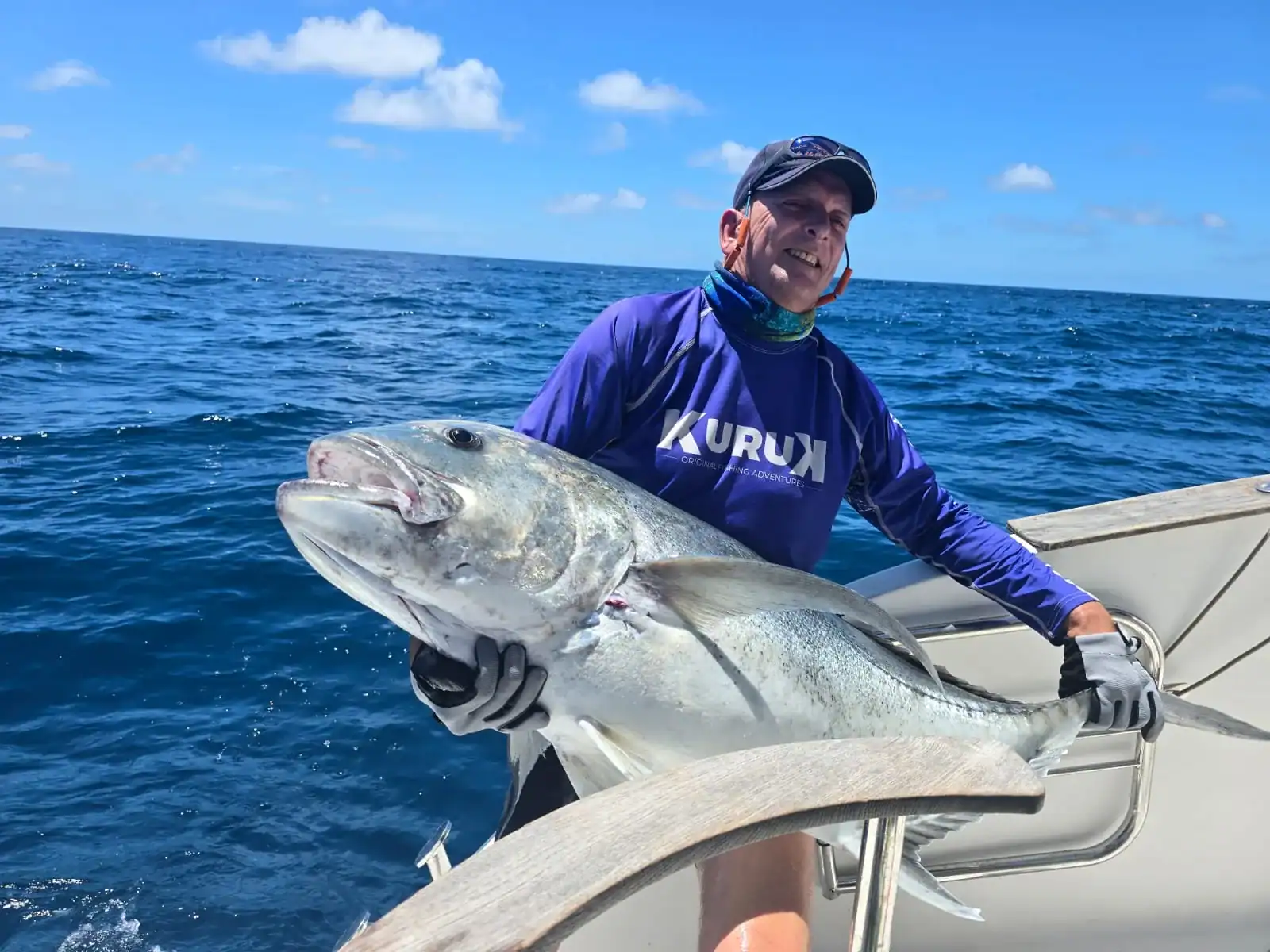
The Giant Trevally (Caranx ignobilis), universally known among anglers as the GT, represents the pinnacle of tropical sport fishing. Dubbed the “gangster of the flats” and the “undisputed thug of the reefs,” this species combines raw explosive power, tactical intelligence, and relentless aggression in ways that have humbled even the most experienced anglers. With maximum recorded weights reaching 80kg (176lbs) and lengths of 170cm (67 inches), the GT is the largest member of the Carangidae family and a fish that can strip hundreds of yards of line in seconds, snap heavy leaders like thread, and destroy improperly rigged tackle with contemptuous ease.
The Seychelles archipelago, comprising 115 islands scattered across a 1.37 million square kilometer Exclusive Economic Zone in the western Indian Ocean, offers some of the world’s premier GT fishing grounds. From the precipitous Mahé drop-off to the remote wilderness of the Amirantes chain and the northern frontier islands of Bird and Denis, these waters provide diverse bathymetric profiles that support thriving GT populations. This comprehensive guide will equip you with the technical knowledge, tactical strategies, and environmental understanding required to successfully target these apex predators.
Understanding Your Adversary: GT Biology and Behavior
Physical Characteristics and Capabilities
The Giant Trevally’s physiology is purpose-built for predation. Its deep, laterally compressed body provides the hydrodynamic profile necessary for sudden directional changes, while its steep head profile and powerful jaw structure allow it to crush prey with devastating force. The species’ tail scutes—sharp, keeled scales along the tail base—facilitate high-torque swimming and explosive bursts of speed reaching up to 37mph.
The GT’s large eyes are adapted for low-light hunting, making them particularly effective predators during dawn, dusk, and overcast conditions. This visual acuity extends to detecting surface disturbances, which explains their remarkable ability to track and strike surface lures from considerable depths.
Dietary Patterns and Prey Selection
Understanding what GTs eat is fundamental to selecting effective lures and fishing locations. The species undergoes significant ontogenetic diet shifts throughout its life cycle. Juveniles inhabit estuaries and shallow bays, feeding primarily on small crustaceans and fish fry. As they mature—typically between three and five years of age—they migrate toward complex reef systems and offshore banks, where their diet expands dramatically.
Adult GTs are opportunistic apex predators that consume virtually anything they can overpower. In Seychelles waters, their primary prey includes fusiliers, bonito, rainbow runners, and various snapper species. However, their menu extends far beyond typical reef fish to include squid, juvenile turtles, and in the most spectacular displays of predatory behavior, even birds.
The famous “bird-eating” behavior observed at Farquhar Atoll, where GTs launch themselves completely out of the water to intercept sooty terns in mid-flight, demonstrates both their explosive power and their reliance on surface-level stimulus. This behavior provides the biological foundation for popping as a technique: the loud splash and acoustic signature of a popper mimics the distress signals of struggling or fleeing prey, triggering the GT’s hardwired predatory response.
Hunting Strategies and Social Behavior
GTs employ both solitary and coordinated hunting strategies. In the Seychelles, they frequently shadow larger predators like sharks and monk seals, positioning themselves to intercept prey flushed from cover by these animals. This “shadowing” behavior means that anglers should look beyond the obvious—the presence of sharks, aggregations of seabirds working the surface, or even unusual water disturbances can all indicate GT activity.
When hunting in schools, GTs often employ coordinated tactics to trap baitfish against structures or the surface, creating feeding frenzies that produce spectacular topwater action. Recognizing these patterns and understanding how GTs position themselves relative to structure, current, and prey is essential for consistent success.
Environmental Mastery: Reading Water, Weather, and Tides
The Tidal Imperative
If there’s one environmental variable that trumps all others in GT fishing, it’s tide. The Giant Trevally’s movement patterns, feeding behavior, and positioning are intimately tied to tidal flow. Understanding this relationship transforms random casting into strategic hunting.
The Incoming Tide: The “pushing” or incoming tide is generally considered the optimal window for GT fishing. As water rises, it carries cooler, nutrient-rich ocean water onto the flats and into surf zones, creating a sensory highway that GTs follow. The rising water provides security—the fish know they won’t be stranded—resulting in more aggressive feeding behavior. Baitfish that have sheltered in shallow areas during low tide suddenly become accessible, and GTs move in to capitalize.
The Outgoing Tide: While less universally productive, the falling tide concentrates baitfish as water drains from lagoons and flats. This creates ambush opportunities at channel mouths, reef passes, and other “pinch points” where prey is funneled into confined areas. At locations like St. Joseph Atoll, the outgoing tide forces baitfish from the lagoon through narrow passes, creating feeding opportunities that GTs rarely ignore.
Lunar Phases and Their Impact
The moon’s gravitational influence dictates tidal magnitude, which in turn affects GT behavior. During new and full moon phases, the Seychelles experiences “spring tides”—the most extreme high and low tides of the month. These spring tides move massive volumes of water at higher velocities, allowing GTs to access areas that remain unreachable during the weaker “neap tides” (first and third quarter moon phases).
Many professional guides specifically target new moon periods for an additional reason: in the absence of moonlight, GTs—despite their excellent low-light vision—cannot hunt effectively at night. This results in concentrated, aggressive daytime feeding as the fish compensate for lost nighttime hunting opportunities.
Seasonal Patterns and Optimal Windows
The Seychelles maintains a tropical marine climate with water temperatures ranging from 23°C to 31°C year-round. However, GT metabolic activity and feeding aggression peak within a narrower thermal band of 26°C to 29°C.
The archipelago experiences two distinct wind patterns: the southeast trades (May through September) and the northwest monsoon (November through March). The transitional periods—October through November and March through May—provide the most favorable conditions for popping. During these months, seas are typically calm, water clarity reaches its peak, and the absence of strong winds allows for accurate long-distance casting and precise lure manipulation.
Seasonal Breakdown:
- January-February: Calm conditions with occasional showers; high GT activity
- March-May: Peak season with very calm, clear water; optimal visibility and fish aggression
- June-August: Southeast trades create rough conditions; lowest activity period
- September: Transitional month with improving conditions
- October-November: Peak season returns; calm water and aggressive fish
- December: Northwest monsoon begins; high activity but occasional rough weather
Interestingly, the rain showers common during monsoon transitions can actually improve fishing by cooling surface temperatures and oxygenating the water, which stimulates increased fish activity.
The Arsenal: Rods, Reels, and Terminal Tackle
Rod Selection: Power Meets Precision
GT popping is often described as “combat fishing,” and your rod is your primary weapon. The standard requirement is a PE10 to PE12 class rod, measuring 7.5 to 8.5 feet in length. This specification isn’t arbitrary—it represents the minimum necessary to achieve casting distances of 40 to 70 meters while possessing the backbone to stop a charging fish intent on reaching the reef.
Key Rod Characteristics:
- Powerful butt section: The lower third of the rod must have enormous lifting power to exert leverage against a fish pulling with 10-15kg of drag
- Progressive taper: The rod should load smoothly during the cast but have massive reserve power in the lower sections
- Quality guides: Large, smooth guides (50mm+ tip guide) that won’t damage braided line during violent fights
- Durable construction: Carbon fiber composite construction that can withstand repeated flexing under maximum load
Premium Rod Examples:
- Carpenter Blues Chaser BLC84/30
- Ripple Fisher F-Stick 83GT
- Hamachi XOS GT’n’Doggie 82
- Temple Reef Levitate Expedition 82
- Patriot Design Exodus 83EXH
These rods typically cost $600-$1,200 but represent insurance against tackle failure during the fight of a lifetime.
Reel Selection: The Drag System Is Everything
Your reel must accomplish three critical tasks: hold sufficient line capacity, provide smooth and reliable drag pressure, and withstand the corrosive saltwater environment. The industry benchmarks are the Shimano Stella 14000-18000 series and Daiwa Saltiga 4500-6500 (or their modern 14000-20000 equivalents).
Critical Reel Specifications:
- Drag capacity: Minimum 12-14kg of smooth, consistent drag pressure
- Line capacity: Must hold at least 300 yards of 80-130lb braided line
- Gear ratio: 5.7:1 to 6.2:1 provides optimal cranking power for working lures and fighting fish
- Sealed bearings: Essential for preventing saltwater intrusion
- Robust bail system: Must withstand repeated shock loads during strikes
Drag Management Philosophy: Many anglers make the mistake of setting drag too light, hoping to “tire out” the fish. With GTs, this is catastrophic. The first 30 seconds of the fight determine success or failure. You must apply maximum safe drag (10-14kg) immediately to turn the fish away from the reef. A tired GT that reaches structure is a lost GT—and lost tackle.
Line and Leader Systems: The Critical Connection
Mainline – Braided Line: Modern PE (polyethylene) braided lines in the 80-130lb class are non-negotiable. Braided line provides near-zero stretch, allowing for solid hook sets at distance and direct transmission of pressure to the fish. Popular choices include:
- Varivas GT-Max PE8-12
- YGK Galis Ultra Cast Man PE8-10
- Daiwa J-Braid Grand x8 80-100lb
- Sunline PE-EGI HG 80-100lb
Load your reel with at least 300 yards, as a large GT can strip 150+ yards on its initial run.
Shock Leader: The connection between braided mainline and lure is where most tackle failures occur. A heavy monofilament or fluorocarbon shock leader (150-250lb test) provides abrasion resistance against coral and the GT’s crushing jaws. The leader should be 8-12 feet long—long enough that even with 20 feet of line out, the knot remains outside the guides during the fight.
Quality leader materials include:
- Momoi Diamond 150-250lb monofilament
- Varivas Shock Leader 150-200lb fluorocarbon
- Sunline Siglon FC 150-200lb
- Grand Max Fluorocarbon 180-250lb
Terminal Hardware:
- Swivels: 250-400lb ball-bearing swivels prevent line twist and provide a connection point for the leader. Quality brands include Owner, Halco, and BKK.
- Split rings: 150-300lb heavy-duty split rings connect swivels to lures. Never use snap clips—a GT’s jaw pressure can bend them open like paper clips.
- Hooks: Replace factory treble hooks with heavy-duty single hooks (7/0 to 10/0) for better hook penetration and safer releases. Owner ST-76 and BKK Lone Diablo are excellent choices.
Knot Mastery: The Weakest Link
The connection between your braided mainline and monofilament leader is the single most critical component of your entire system. A poorly tied knot is catastrophic—there are no second chances with a trophy GT.
The FG Knot (Fine Gloss)
The FG knot is the gold standard for braid-to-mono connections in saltwater fishing. When tied correctly, it retains approximately 95% of the line’s breaking strength and creates a slim, smooth connection that passes through rod guides with minimal friction.
Step-by-Step FG Knot Instructions:
- Setup: Hold the leader material between your big toe and second toe (or use a fixed point if on a boat). Pull it taut with your non-dominant hand.
- Initial Wraps: Take the braided mainline and create 15-20 wraps around the leader, alternating the braid over and under the leader with each wrap. Maintain tension throughout.
- Securing Wraps: After completing the wraps, hold the braid and leader together. Create 3-4 half-hitches with the braid around the leader, moving toward the standing end of the leader.
- Reverse Direction: Now create 3-4 half-hitches in the opposite direction, moving back toward the main wraps.
- Final Lock: Create a final double overhand knot with the braid tag end around both the leader and the braid itself.
- Trimming: Carefully trim the leader tag end close to the knot. Trim the braid tag end, leaving approximately 2mm.
- Testing: Pull test the knot gradually before your first cast. A properly tied FG knot should not slip.
Pro Tip: Wet the knot thoroughly with saliva before final tightening to reduce friction heat that can weaken the line.
The PR Bobbin Knot
The PR (Packbay/Power) knot is an alternative favored by many professional anglers for its consistency and strength. It requires a specialized bobbin tool but creates an incredibly strong, slim connection.
The PR knot uses a bobbin to maintain consistent tension while wrapping the braid around the leader material. The tool ensures uniform wraps, which is the key to maximum knot strength. While the FG can be tied in the field, many anglers pre-tie PR knots at home and store spooled leaders for quick connections on the water.
The Improved Bristol Knot
For anglers who struggle with the FG or PR, the Improved Bristol offers a simpler alternative while still maintaining 90%+ knot strength.
Steps:
- Create a loop in the end of your leader material (about 4 inches long)
- Pass 6-8 inches of braided line through the loop
- Wrap the braid around both strands of the loop 15-20 times, working toward the open end
- Pass the braid tag back through the loop
- While holding everything carefully, pull the leader ends to close the loop, trapping the braided wraps
- Moisten and tighten completely
- Trim both tag ends
Loop Knots for Lures
For attaching lures to your leader, many anglers use a loop knot rather than a direct connection. Loop knots allow the lure to move more freely, enhancing its action in the water.
The Homer Rhode Loop is particularly effective:
- Tie a simple overhand knot 6-8 inches from the leader end, leaving it loose
- Thread the leader through the lure’s attachment point
- Pass the tag end back through the overhand knot, going through in the same direction it exited
- Wrap the tag end around the standing line 4-5 times
- Pass the tag end back through the overhand knot one final time
- Moisten and tighten both the wraps and the overhand knot
- Trim the tag end
The resulting loop should be approximately 1/4 to 1/2 inch in diameter, allowing the lure natural movement while maintaining full knot strength.
Lure Selection and Hydrodynamics
Popper Design and Function
Poppers are the quintessential GT lure—purpose-built to create surface disturbance that mimics struggling prey. The design centers on a cupped or concave face that captures water during the retrieve, creating the distinctive “pop” sound and forward splash that attracts fish from distance and depth.
Key Popper Characteristics:
- Weight: 150-300 grams for long-distance casting in typical Seychelles conditions
- Cup depth: Deeper cups create louder, more aggressive pops; shallower cups produce subtler disturbances for calmer conditions or pressured fish
- Body profile: Wider bodies create more water displacement; streamlined profiles cast farther in windy conditions
- Through-wire construction: Essential for withstanding GT jaw pressure and fighting loads
Top Popper Models:
- Halco Roosta 195mm (135-160g): The industry standard; versatile and proven
- Patriot Design Hamachi Pop 195 (180g): Excellent long-distance casting
- Heru Cubera 195 (200g): Aggressive cup design for rough water
- FCL Labo CSP-200 (200g): Premium construction with perfect balance
- Craftbait GT3 195 (150g): Great action in calmer water
Stickbait Strategy
While poppers get the headlines, stickbaits are often the secret weapon for educated or pressured GTs. These lures have a streamlined profile without the popper’s cup face, creating a more subtle presentation.
Floating Stickbaits: These lures sit on the surface and are worked with a “walk-the-dog” retrieve—a rhythmic side-to-side action created by sharp, downward rod twitches. This presentation is highly effective when fish are visible but refusing aggressive poppers.
Sinking Stickbaits: These lures allow you to work the water column down to 35 meters. The sinking action itself often triggers strikes, and the ability to count down to specific depths lets you target fish holding deeper in the water column.
Top Stickbait Models:
- Patriot Design Hamachi Stick 230 (200g sinking): Versatile depth coverage
- Shimano Orca 200F (73g floating): Classic walk-the-dog action
- Heru Skipjack 180 (125g floating): Excellent in calm water
- Albacore Manu 200 (180g sinking): Rapid sink rate for deep fish
Color Selection: Science and Superstition
In the crystal-clear waters of the Seychelles, lure color matters more than in turbid or deep water. While GTs will strike virtually any color when actively feeding, certain patterns consistently outperform others.
Proven Color Patterns:
- Pink Candy/Nemo Pink: The single most effective color in Seychelles waters; high visibility and resembles dawn/dusk light conditions
- Purple/Violet: Excellent in low-light conditions and deeper water
- Rainbow/Holographic: Reflects light at multiple angles; effective in bright conditions
- Chartreuse/Yellow: High visibility in choppy water or during overcast conditions
- Natural Patterns (silver, blue mackerel, bonito): Effective when fish are feeding on specific prey species
Color Strategy: Start with high-visibility colors (pink, purple, rainbow) unless you observe fish actively feeding on specific prey, in which case match the hatch with natural patterns.
Regional Strategies: Where and How to Fish
Mahé Plateau and the Drop-Off
The Mahé Plateau is a massive submarine bank where average depths of 40-60 meters suddenly plunge to 2,000+ meters at the drop-off edge. This dramatic transition creates powerful currents that concentrate nutrients and baitfish, attracting GTs from both reef systems and open water.
Tactical Approach:
- Launch from Victoria or Eden Island for access to the drop-off zone
- Use sonar to identify “pressure points” where oceanic currents collide with the plateau edge
- Monitor surface activity—bird concentrations indicate baitfish schools and feeding predators
- Cast toward current seams and temperature breaks
- Use larger poppers (200-300g) for the rougher offshore conditions
- Employ a slower retrieve with extended pauses, allowing acoustic signatures to travel through deeper water columns
Retrieve Pattern for Deep Water: Pop-pop-pause (5-7 seconds), pop-pop-pause. The extended pause gives fish holding at 20+ meters time to locate and rise to the lure.
The Amirante Islands
Located 230 kilometers southwest of Mahé, the Amirantes represent some of the most pristine and productive GT waters on Earth. This remote chain of coral islands and atolls sits along the Amirantes Trench, which plunges from 60 meters to over 12,000 meters.
Desroches Island: This unique “underwater atoll” features a reef structure that descends into the abyss, creating complex terrain of tunnels, ravines, and crevices. November through May provides optimal conditions with flat seas and exceptional visibility.
Technique: Drift along the reef edge, casting toward “white water” where waves break over coral. The breaking waves disorient baitfish and create feeding opportunities that GTs exploit aggressively.
St. Joseph Atoll: Thirteen small islands surround a central lagoon with narrow passes that concentrate baitfish during tide changes.
Technique: Position at lagoon passes during falling tides and work poppers in the current as baitfish are funneled toward open water. GTs ambush prey in these bottleneck areas.
Poivre Atoll: Located 13 miles from St. Joseph, Poivre offers extreme trench dynamics where massive GTs patrol the outer reef slopes.
Technique: Alternate between surface popping along the reef edge and deep jigging (200-400g jigs) along the trench wall. The sheer drop-off creates powerful upwellings that support exceptional marine diversity.
African Bank: This exposed reef system at the northern end of the Amirantes is known for “ultra-aggressive” GTs that are constantly in high-activity mode.
Technique: Use aggressive retrieve patterns with minimal pausing. The fish here respond to fast-moving lures that mimic rapidly fleeing prey.
Bird and Denis Islands: The Northern Frontier
Bird and Denis Islands mark the northern rim of the Seychelles Bank, offering unique access to deep-water predators within minutes of shore.
Denis Island: The legendary “15-minute drop-off” makes Denis a special destination. Deep-water predators patrol just offshore, while the island’s reef flats offer opportunities for sight fishing and fly fishing.
Technique: Work the reef flats during incoming tides for shallow-water sight casting. Move offshore to the drop-off during slack tides for deeper presentations.
Bird Island: One of the few locations in the Seychelles where effective shore fishing for GTs is possible.
Technique: Wade the reef flats during optimal tide windows, casting toward channels and deeper pockets. Bring wading boots for coral protection and practice extreme stealth in the shallow, clear water.
Tactical Engagement: The Art of the Strike
Stealth and Approach
In shallow water and on reef flats, GTs become extraordinarily wary. Your approach determines whether fish feed or flee.
Boat Positioning:
- Drift quietly with the current rather than motoring into position
- Position upwind/up-current to allow silent drifts through productive zones
- Stay at least 40-50 meters from visible fish in shallow water
- Avoid creating bow wakes that telegraph your presence
Casting Strategy:
- Lead cruising fish by 15 feet—allow them to “swim onto” the lure
- Landing a lure directly on top of a fish causes immediate flight response
- In deeper water (10+ meters), longer leads are less critical
- Cast beyond visible structure and retrieve the lure parallel to edges
The Retrieve: Triggering the Strike
Your retrieve pattern makes or breaks GT popping. The goal is to imitate injured, fleeing prey—something struggling to escape.
Standard Popping Retrieve:
- Initial attraction: Two sharp pops to get the fish’s attention
- Pause: 2-3 seconds in calm water, 5-7 seconds in rough water or when targeting deeper fish
- Acceleration: As the fish approaches, increase retrieve speed
- Commitment: Once the fish commits, maintain speed—GTs often abort strikes if prey “stops running”
The Chase Response: GTs are hardwired to pursue fleeing prey. A lure that stops or slows dramatically during the chase often triggers suspicion rather than aggression. Keep the lure moving once the fish shows interest.
Stickbait Retrieve:
- Sharp, rhythmic downward twitches create the walk-the-dog action
- Maintain tension on the line throughout the retrieve
- Vary the cadence—sometimes erratic action triggers reluctant fish
- Allow brief pauses between twitch sequences
The Strike and Hook-Set
A GT strike is explosive, violent, and unmistakable. The water erupts, your line goes tight, and your drag screams. Your response in the next two seconds determines the outcome.
The Strip-Set Technique: Many anglers instinctively lift the rod when a fish strikes—the “trout set.” This is wrong for GTs. Instead:
- Keep the rod tip pointed at the fish at a 45-degree angle to the water
- Pull the line hard with your non-rod hand—strip 2-3 feet of line violently
- Repeat 2-3 times to drive the heavy hooks through the GT’s hard jaw
- Then engage with the rod, sweeping it to the side while reeling to take up slack
This technique ensures solid hook penetration before transitioning to rod-and-reel fighting.
The Fight: Combat Fishing at Its Finest
The Critical First 30 Seconds
The outcome of the fight is largely determined in the first half-minute after hook-set. Your primary objective is simple: turn the fish away from the reef. Every second the GT spends swimming toward structure increases the odds of a lost fish and lost tackle.
Drag Strategy:
- Lock down to 10-14kg of drag immediately
- Use the rod’s leverage to turn the fish’s head
- Position yourself so you’re pulling perpendicular to the fish’s direction of travel
- If the fish reaches structure, point the rod directly at it and apply steady pressure—sometimes GTs will turn and come out on their own
Body Positioning:
- Brace yourself against the boat’s gunwale or fighting belt
- Use your legs and core for leverage, not just your arms
- Keep the rod at a 45-60 degree angle to maximize leverage
- Never “high-stick” (rod past vertical)—this is how rods break
The Extended Battle
Once you’ve turned the fish and established control, the fight transitions to a war of attrition. Large GTs commonly fight for 20-45 minutes, with trophy fish exceeding an hour.
Fighting Technique:
- Pump and wind: lift the rod smoothly, then reel down as you lower the rod
- Maintain constant pressure—giving a GT slack allows it to rest and plan its next move
- If the fish sounds (dives deep), increase drag slightly and prepare for another run
- Follow the fish with your body and rod position if it circles the boat
The End Game: As the fish tires, it will circle near the surface. This is when many fish are lost due to angler complacency.
- Keep the rod bent and pressure constant
- Have your landing strategy planned—will you gaff, net, or hand-land?
- For catch and release, bring the fish alongside the boat while still in the water
- Support the fish horizontally if you must lift it for photos—never hold by the jaw/gill plate only
Conservation and Ethical Practices
The Case for Catch and Release
Giant Trevally are apex predators that grow slowly and reach sexual maturity relatively late (3-5 years). They’re vulnerable to overfishing pressure, particularly in heavily fished areas. The international sport fishing community in the Seychelles strongly advocates for catch and release practices.
Proper Handling Protocol:
- Fight time: Land the fish as quickly as possible to reduce physiological stress
- Handling: Always use wet hands; never touch fish with dry hands or gloves
- Keep in water: Conduct the release with the fish remaining in the water whenever possible
- Support properly: If lifting for photos, support horizontally with one hand under the belly and one at the tail
- Photo speed: Limit air exposure to 10-15 seconds maximum
- Revive if needed: Hold the fish upright in the current, moving it forward gently to pass water over the gills
- Release when ready: The fish should swim away strongly under its own power
Barbless Hooks: Using barbless hooks or crimping the barbs dramatically reduces release time and tissue damage. Many professional guides require barbless hooks on their boats.
Single Hooks vs. Trebles: Replacing factory treble hooks with heavy single hooks (7/0 to 10/0) improves hook-up ratios, provides better penetration, and makes releases faster and safer for both fish and angler.
Regulatory Compliance
Protected Areas: Marine National Parks, including Ste. Anne and certain zones around Denis Island, prohibit all fishing. Research your destination’s specific regulations before fishing.
Species Protection: All sharks, rays, and marine mammals are protected under Seychelles law. If hooked accidentally, release immediately with minimal handling.
Catch Limits: The Mahé Plateau Trap and Line Fishery Co-management Plan establishes catch limits for certain species to prevent overfishing. Current limits include a maximum of 20 demersal fish per day, with size restrictions for specific species (32cm minimum for red snapper and green jobfish).
Conclusion: The Holistic Approach
Success in Seychelles GT popping requires far more than expensive tackle and raw enthusiasm. It demands environmental literacy—the ability to read tides, interpret lunar phases, and understand how water temperature affects fish metabolism. It requires technical precision in knot tying, lure selection, and retrieve cadence. Most importantly, it demands respect for these apex predators and commitment to their conservation.
Whether you’re working the dramatic depths of the Mahé drop-off, exploring the remote wilderness of the Amirantes, or casting from the northern frontier of Bird and Denis Islands, the core principles remain constant: use properly matched heavy-duty tackle, execute technical casting and retrieve patterns with precision, and prioritize the fish’s wellbeing through ethical catch-and-release practices.
The Giant Trevally has earned its reputation as one of sport fishing’s ultimate challenges. By following the strategies outlined in this guide—from understanding fish behavior and environmental variables to mastering tackle configurations and fighting techniques—you maximize your chances of connecting with these legendary fish while ensuring the Seychelles’ world-class GT fishery remains productive for generations to come.
The gangster of the flats awaits. Are you ready?